
Simulide 2.0.0


Quote from alfsimu on May 12, 2026, 5:25 pmHi all ! thank's to archachofo for this very nice tools.
I come from build simulide 2.0.0 260503 on linux archlinux style distrib.
I have a curious bug just testing the capacitor charge ...and the capacitor have a big current auto discharge setting but any setting for the leakage current if double click on the capacitor... If i test on the stable version of simulide v1 sr2 once the capacitor is charged the voltage stay the same in the capacitor..but not in the v2...so perhaps add a setting to be abble to set the self discharge setting of a capacitor ? But for now the default setting set is too big...
Perhaps you must allow .sim2 file attachement ..i have add to zip the .sim2 schematic to be abble to attach.
Hi all ! thank's to archachofo for this very nice tools.
I come from build simulide 2.0.0 260503 on linux archlinux style distrib.
I have a curious bug just testing the capacitor charge ...and the capacitor have a big current auto discharge setting but any setting for the leakage current if double click on the capacitor... If i test on the stable version of simulide v1 sr2 once the capacitor is charged the voltage stay the same in the capacitor..but not in the v2...so perhaps add a setting to be abble to set the self discharge setting of a capacitor ? But for now the default setting set is too big...
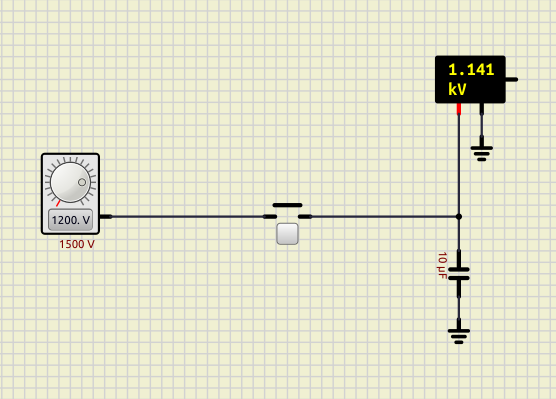
Perhaps you must allow .sim2 file attachement ..i have add to zip the .sim2 schematic to be abble to attach.
Uploaded files:Quote from arcachofo on May 12, 2026, 5:33 pmQuote from alfsimu on May 12, 2026, 5:25 pmHi all ! thank's to archachofo for this very nice tools.
I come from build simulide 2.0.0 260503 on linux archlinux style distrib.
I have a curious bug just testing the capacitor charge ...and the capacitor have a big current auto discharge setting but any setting for the leakage current if double click on the capacitor... If i test on the stable version of simulide v1 sr2 once the capacitor is charged the voltage stay the same in the capacitor..but not in the v2...so perhaps add a setting to be abble to set the self discharge setting of a capacitor ? But for now the default setting set is too big...
Perhaps you must allow .sim2 file attachement ..i have add to zip the .sim2 schematic to be abble to attach.
Hi.
In Simulide capacitors don´t auto-discharge.
I think the capacitor discharges through Volt meter, you can test using a Probe instead of voltmeter.
Quote from alfsimu on May 12, 2026, 5:25 pmHi all ! thank's to archachofo for this very nice tools.
I come from build simulide 2.0.0 260503 on linux archlinux style distrib.
I have a curious bug just testing the capacitor charge ...and the capacitor have a big current auto discharge setting but any setting for the leakage current if double click on the capacitor... If i test on the stable version of simulide v1 sr2 once the capacitor is charged the voltage stay the same in the capacitor..but not in the v2...so perhaps add a setting to be abble to set the self discharge setting of a capacitor ? But for now the default setting set is too big...
Perhaps you must allow .sim2 file attachement ..i have add to zip the .sim2 schematic to be abble to attach.
Hi.
In Simulide capacitors don´t auto-discharge.
I think the capacitor discharges through Volt meter, you can test using a Probe instead of voltmeter.
Quote from alfsimu on May 13, 2026, 8:24 amI have just done the test !
With the probe and no voltmeter this is the same ..discharge of the cap !
To isolate the problem i have put a push button between the measurement point and the Probe ...so this do a sampling point just take current when push for sampling...and this show you are right this is the Voltmeter or probe that discharge...i stay running the simulation 5 min..push the button and the voltage was always at top and just start to discharge a little with the measurement...
And i have put the Oscope only and the Oscope discharge the cap too...oups this is not a very HIGH impedance scope..a very very old one style..funny things !
So i have the idea to try to measure the leakage current i put Ampmeter and wonderfull Simulide can show the leakage current of the buggy measurement tools very funny and very good !
And with the probe current :
I have done the test too on the 1.1.0-SR1 and if i put a probe the discharge occurs too ! So this may be a bug too on the probe on the stable version ? and on the probe and on the voltmeter and on the oscope of the dev ?
Many thanks. have a nice day.
I have just done the test !
With the probe and no voltmeter this is the same ..discharge of the cap !
To isolate the problem i have put a push button between the measurement point and the Probe ...so this do a sampling point just take current when push for sampling...and this show you are right this is the Voltmeter or probe that discharge...i stay running the simulation 5 min..push the button and the voltage was always at top and just start to discharge a little with the measurement...
And i have put the Oscope only and the Oscope discharge the cap too...oups this is not a very HIGH impedance scope..a very very old one style..funny things !
So i have the idea to try to measure the leakage current i put Ampmeter and wonderfull Simulide can show the leakage current of the buggy measurement tools very funny and very good !
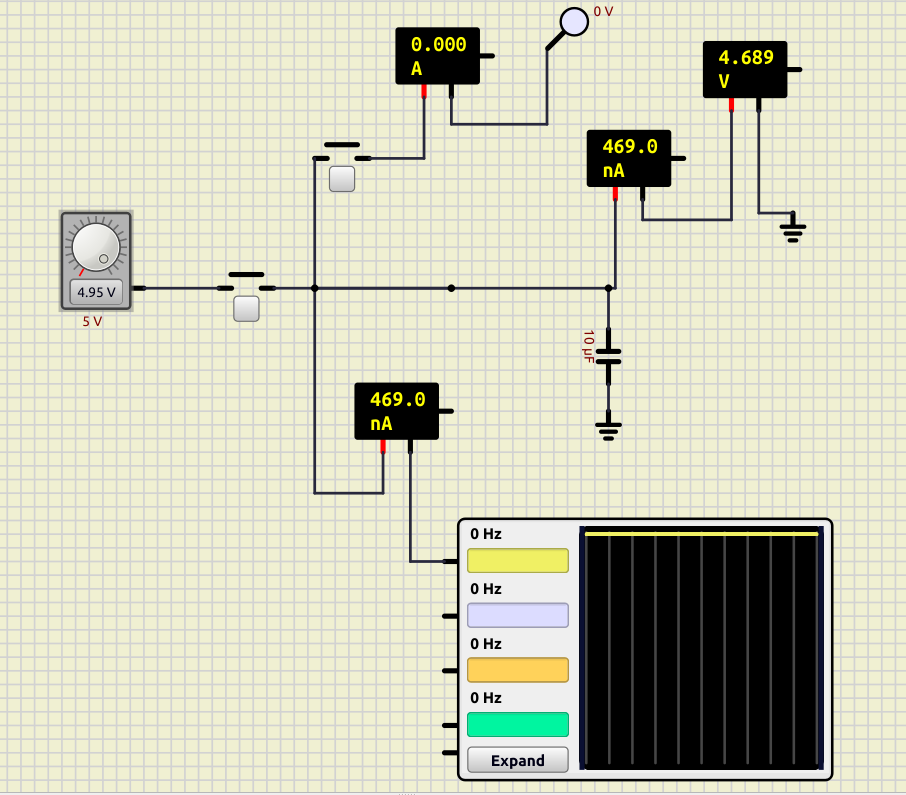
And with the probe current :
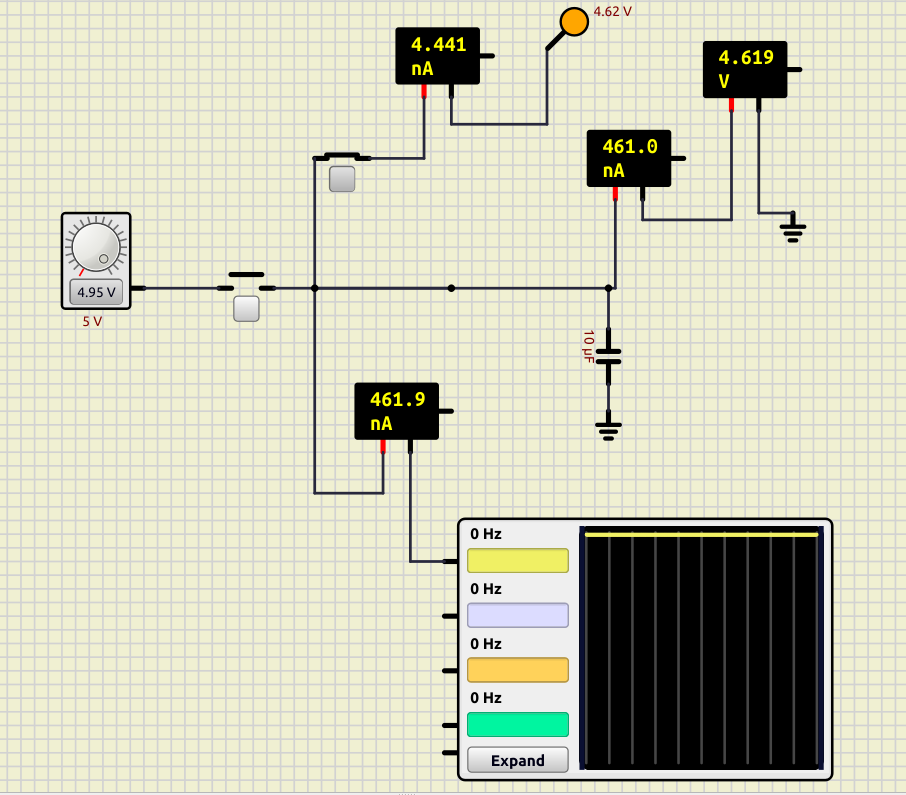
I have done the test too on the 1.1.0-SR1 and if i put a probe the discharge occurs too ! So this may be a bug too on the probe on the stable version ? and on the probe and on the voltmeter and on the oscope of the dev ?
Many thanks. have a nice day.
Quote from arcachofo on May 14, 2026, 11:32 amSorry, I didn't explain very well.
I mean a Probe not connected, just hovering in the wire.
This way you can see the voltage without interacting with it:
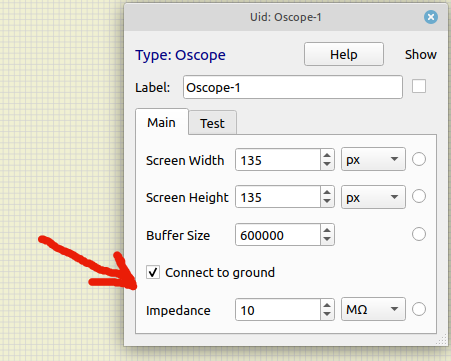
About Oscilloscope, you can configure impedance:
In conclusion:
There is no bug in the capacitor or meters.
Meters have some resistance that can discharge the capacitor. With the exception of:
- Probe when is not connected.
- Oscilloscope if configured accordingly.It is true that impedance for Volt meter is lower in version 2.0.0 (10 MΩ), but still in the range of a normal one.
Any way I will increase it a bit more.Thank you for all the testing.
Sorry, I didn't explain very well.
I mean a Probe not connected, just hovering in the wire.
This way you can see the voltage without interacting with it:
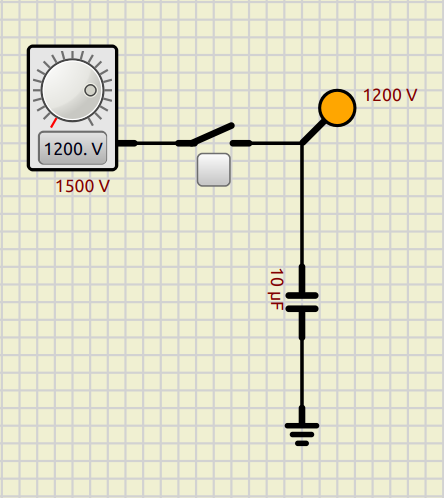
About Oscilloscope, you can configure impedance:
In conclusion:
There is no bug in the capacitor or meters.
Meters have some resistance that can discharge the capacitor. With the exception of:
- Probe when is not connected.
- Oscilloscope if configured accordingly.
It is true that impedance for Volt meter is lower in version 2.0.0 (10 MΩ), but still in the range of a normal one.
Any way I will increase it a bit more.
Thank you for all the testing.
Quote from alfsimu on May 16, 2026, 8:42 pmGood point 👍
Right now the input impedance is more like a “standard electronics” setup (fixed ~10MΩ), but for low current / high impedance measurements it can disturb the circuit too much.
Could be nice to add:
* adjustable voltmeter impedance
* probe impedance/capacitance settings
* optional auto impedance depending on measurement rangeLike on real lab instruments:
* under ~100V → often >10GΩ
* higher ranges → usually 10MΩ
* scope probes x1/x10 → different resistance + capacitanceThat would help a lot for:
* sensitive analog circuits
* sensors
* leakage/current measurements
* very high value resistorsMaybe presets could work well too:
* Standard DMM
* Bench DMM
* Electrometer
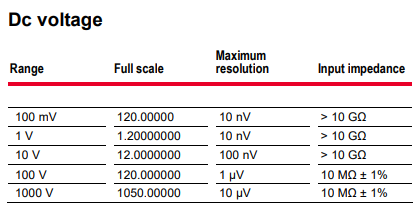
* Scope probe x1/x10Probably the fixed value was chosen to keep the simulator stable/simple, but having advanced impedance settings would definitely improve realism for precision measurements. Here table of a laboratory equipement multimeter :
But I don’t really know your exact goal, so maybe you intentionally kept those settings because they fit your devel and purpose for this project 🙂 !. thank's again. have a nice day.
Good point 👍
Right now the input impedance is more like a “standard electronics” setup (fixed ~10MΩ), but for low current / high impedance measurements it can disturb the circuit too much.
Could be nice to add:
* adjustable voltmeter impedance
* probe impedance/capacitance settings
* optional auto impedance depending on measurement range
Like on real lab instruments:
* under ~100V → often >10GΩ
* higher ranges → usually 10MΩ
* scope probes x1/x10 → different resistance + capacitance
That would help a lot for:
* sensitive analog circuits
* sensors
* leakage/current measurements
* very high value resistors
Maybe presets could work well too:
* Standard DMM
* Bench DMM
* Electrometer
* Scope probe x1/x10
Probably the fixed value was chosen to keep the simulator stable/simple, but having advanced impedance settings would definitely improve realism for precision measurements. Here table of a laboratory equipement multimeter :
But I don’t really know your exact goal, so maybe you intentionally kept those settings because they fit your devel and purpose for this project 🙂 !. thank's again. have a nice day.